Industry challenge and component role
PMI core selection context
CNC machining and core geometry
Composite manufacturing and project RFQ
Aerospace review lens
Read the structure before the material label.
Component
Panel, shell, fairing or internal feature defined by drawing.
Structure
Skins, core, interfaces and geometry considered together.
Programme
Process, documentation and inspection established project by project.
Engineering record
Component context
Core & geometry
Process & review

Start from the component challenge
A useful application discussion defines the structural component, intended service context, laminate concept, geometry, and manufacturing requirements before a material choice is finalized.
Engineering data and quality considerations
Density, thickness, properties, inspection, and process details must be verified against the actual product grade, applicable datasheet, and project requirements.
Aerospace context starts with the structural component
Aerospace and aviation composite discussions should begin with the actual component, its geometry, laminate concept, manufacturing route, and documentation requirements. The page provides an application framework; it does not make unverified airworthiness, certification, or flight-performance claims.
Core geometry can be as important as the material family
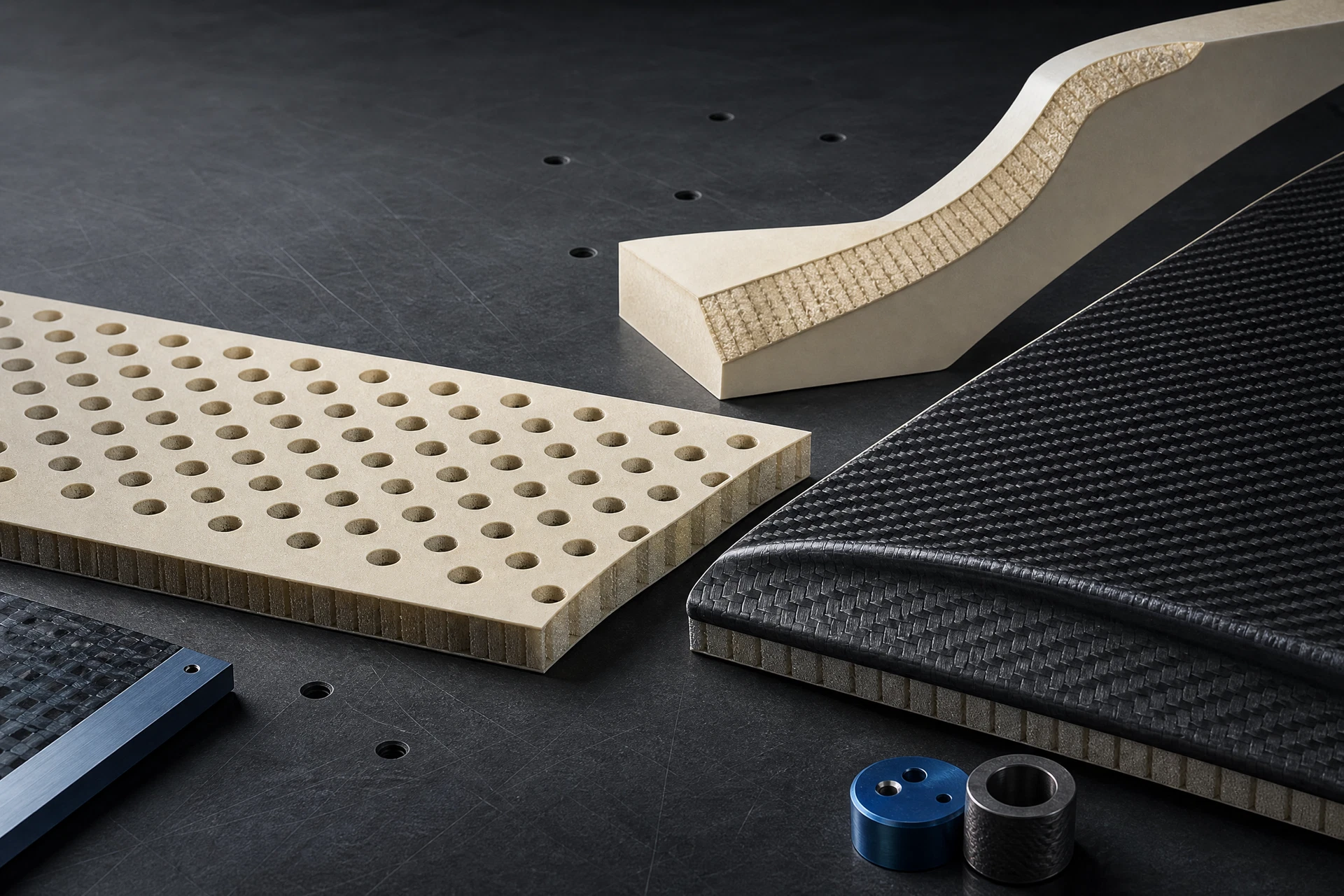
A shaped panel, fairing-like component, internal sandwich detail, or UAV-adjacent structure may need contours, drill features, edge transitions, or custom interfaces in the core. These requirements influence whether the enquiry is best framed around sheet, block, custom core, or CNC-machined PMI foam geometry.
Match the core discussion to composite manufacturing
The material discussion should be connected to the intended laminate and manufacturing path. Cure method, resin system, tooling, vacuum or pressure context, and handling are relevant project inputs, but their technical implications must be confirmed against the selected grade and applicable documentation.
Use a documented RFQ path
For an aerospace-related enquiry, provide the component context, CAD or drawing, known material constraints, target geometry, intended processing, and inspection or documentation expectations. This helps create a scoped technical conversation without inferring requirements that have not been supplied.
Why aerospace sandwich structures start with structural context
Aerospace PMI foam discussions should begin with the component: a panel, fairing-like shell, secondary structure, UAV-adjacent part or internal sandwich detail. Weight reduction is only one objective. Geometry, face-sheet concept, core role, processing documentation, inspection requirements and programme controls all determine what must be reviewed before a material or preparation route is selected.
Read the sandwich as faces, core and interfaces
A sandwich structure is not simply a lightweight panel. The outer skins, core, adhesive or resin interfaces and edge or insert details each need to work in the actual geometry. PMI core form and thickness should be considered as part of the overall separation and support concept, while the selected grade data and laminate design remain subject to programme-specific confirmation.
Use process context to frame the engineering review
Prepreg, autoclave, RTM, vacuum infusion and other routes introduce different tooling, handling and documentation questions. The appropriate route should be identified from the actual component, selected grade documentation and programme requirements. This page provides a framework for that review; it does not claim airworthiness approval, cure suitability or a verified aerospace process window.
CNC geometry often connects the core to the outer structure
Aerospace-related components may need shaped panels, curved profiles, local reliefs, holes, grooves, interface edges or repeatable features in the core. CAD review helps distinguish an illustrative form from production-defining geometry, and allows core preparation to be connected to mould, laminate, bonding or assembly references.
Quality and procurement need a controlled information path
The project brief can identify the relevant drawing revision, material documentation request, feature references, inspection expectations, part marking, handling and packing needs. Certification, qualification and flight or test evidence must be provided through the actual programme and verified documentation; a sector-oriented webpage cannot substitute for those controls.
Prepare an aerospace-oriented PMI enquiry
Include the component function, drawing or CAD package, laminate or process context if available, core form direction, required geometry, engineering questions and any documentation expectations. This gives the technical review enough context to establish the appropriate next material and machining conversation without inferring requirements from the industry name alone.
Related questions
Questions that make the next engineering conversation more useful.
01Does this page claim aerospace certification?
No. The page describes an application context only. Certification, qualification, testing, and material suitability must be confirmed for the actual programme using the applicable project requirements and verified documentation.
02Can an aerospace-related PMI core project include CNC geometry?
Yes, where the drawing and project requirements call for it. Send the applicable CAD or drawing so core form, machining scope, and the required review can be discussed together.
03Why is PMI foam considered for aerospace sandwich structures?
PMI foam may be evaluated where a lightweight sandwich construction, core geometry and composite manufacturing route need to be considered together. Final suitability follows programme requirements and applicable grade documentation.
04Can PMI foam be used for UAV structures?
UAV projects can be organized around the component, CAD geometry, repeated-build context and process route. The appropriate material and preparation path must be confirmed for the specific project.
05Can aerospace panels use CNC-machined core geometry?
Where the drawing calls for contoured, drilled, grooved or interfacing core features, a CNC review can connect the CAD model to the composite component workflow.
06Does this page establish aerospace certification?
No. It is an engineering information page. Qualification, certification, material release and programme approval require verified documentation and the actual project process.
07How is thickness selected for an aerospace PMI core?
Thickness is reviewed with the sandwich geometry, skin construction, component form, selected material documentation and programme requirements, not as a generic recommendation.
08What composite processes should be mentioned in the RFQ?
Mention the intended laminate and manufacturing route, such as prepreg, autoclave, RTM or vacuum process context, together with the known component and material requirements.
09What should be inspected on a prepared core?
Inspection discussion should identify the drawing-controlled surfaces, interfaces, feature references and packing or handling requirements for the actual part.
10How do I request technical support for an aerospace core project?
Use the RFQ to share the component, model or drawing, core geometry, process context, documentation request and technical questions for project-specific review.
11How should aerospace pmi foam core be specified?
Start with the component, laminate concept, operating conditions, geometry, and manufacturing route. The applicable material grade and technical data should be confirmed against the specific project.
12Can a drawing be reviewed before a quotation?
Yes. STEP, STP, STL, DXF, DWG, PDF, and ZIP files can be submitted with an RFQ so the team can review the core form, machining scope, and information required for a project-specific response.