
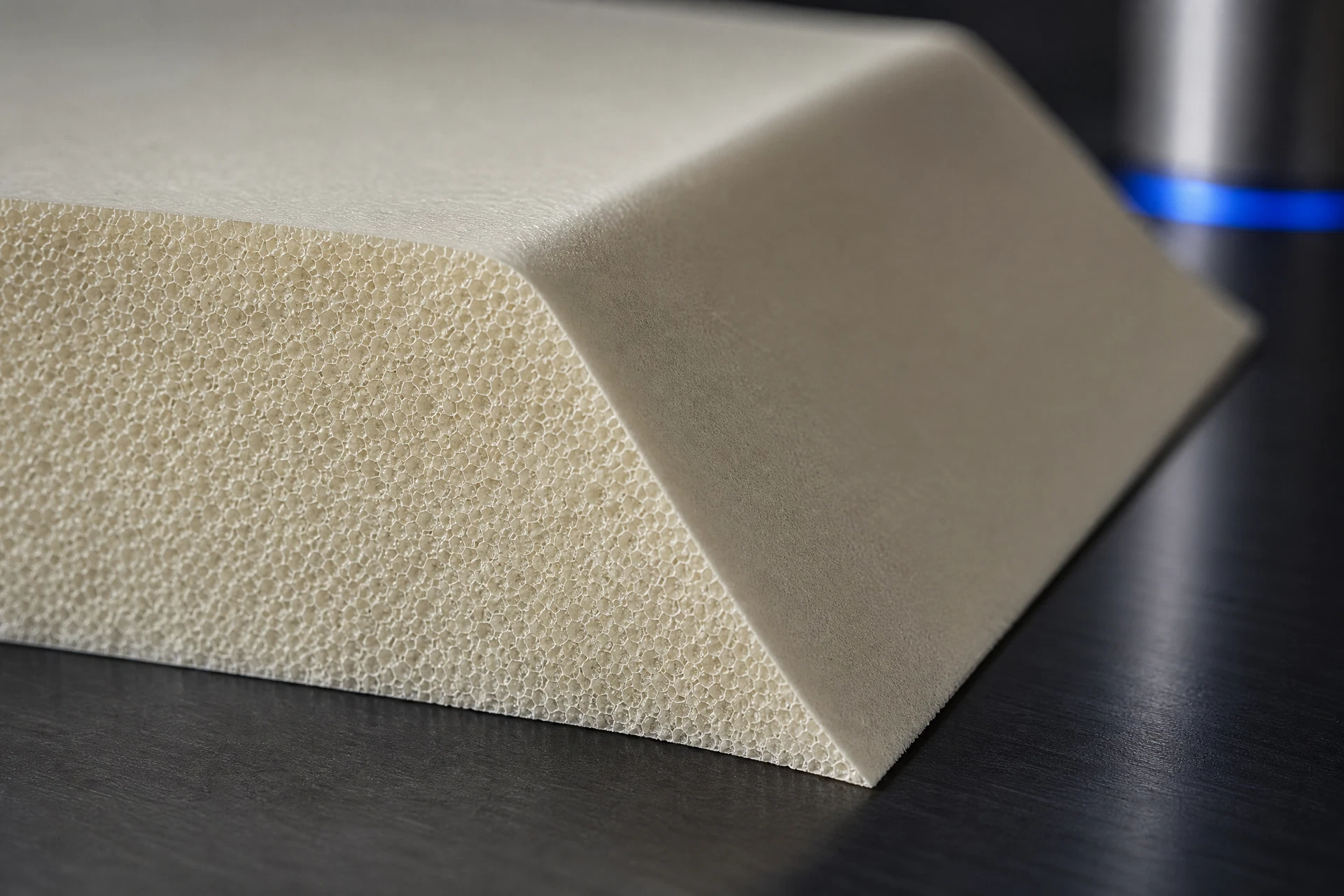
Radome sandwich construction
Curvature and controlled core geometry
RF data request boundary
Programme-level verification
Engineering record
Component context
Core & geometry
Process & review
Treat the radome as a constructed system
A radome combines a protective or structural enclosure with antenna-related functional requirements. The useful core discussion identifies face sheets, core thickness, interfaces, curvature, edge details and any attachment zones. PMI foam is considered as one element of that construction; the actual material and finished-system response must be demonstrated for the programme rather than assumed from a material family.
Keep RF and dielectric questions evidence-led
Terms such as dielectric constant, loss tangent and transmission require the exact grade, test condition, frequency context and programme acceptance method. The provided TDS may offer typical reference values for named grades, but those values do not validate a finished radome. Request the applicable document and set out the RF questions that require formal verification.
Let CAD define the core pathway
Curved shells, double-curved transitions, local interfaces and controlled edges should be shown in the model or drawing. This allows the team to assess whether a sheet, formed pathway or machined core is relevant and how the core connects to moulding, laminate and inspection operations.
Related questions
Questions that make the next engineering conversation more useful.
01Can generic dielectric data prove radome performance?
No. Finished-system performance requires project-specific verification using the actual grade, construction and RF requirements.
02What should a radome PMI foam enquiry include?
Include CAD or drawings, face-sheet context, core thickness, process route, RF-data request and the programme’s validation question.