
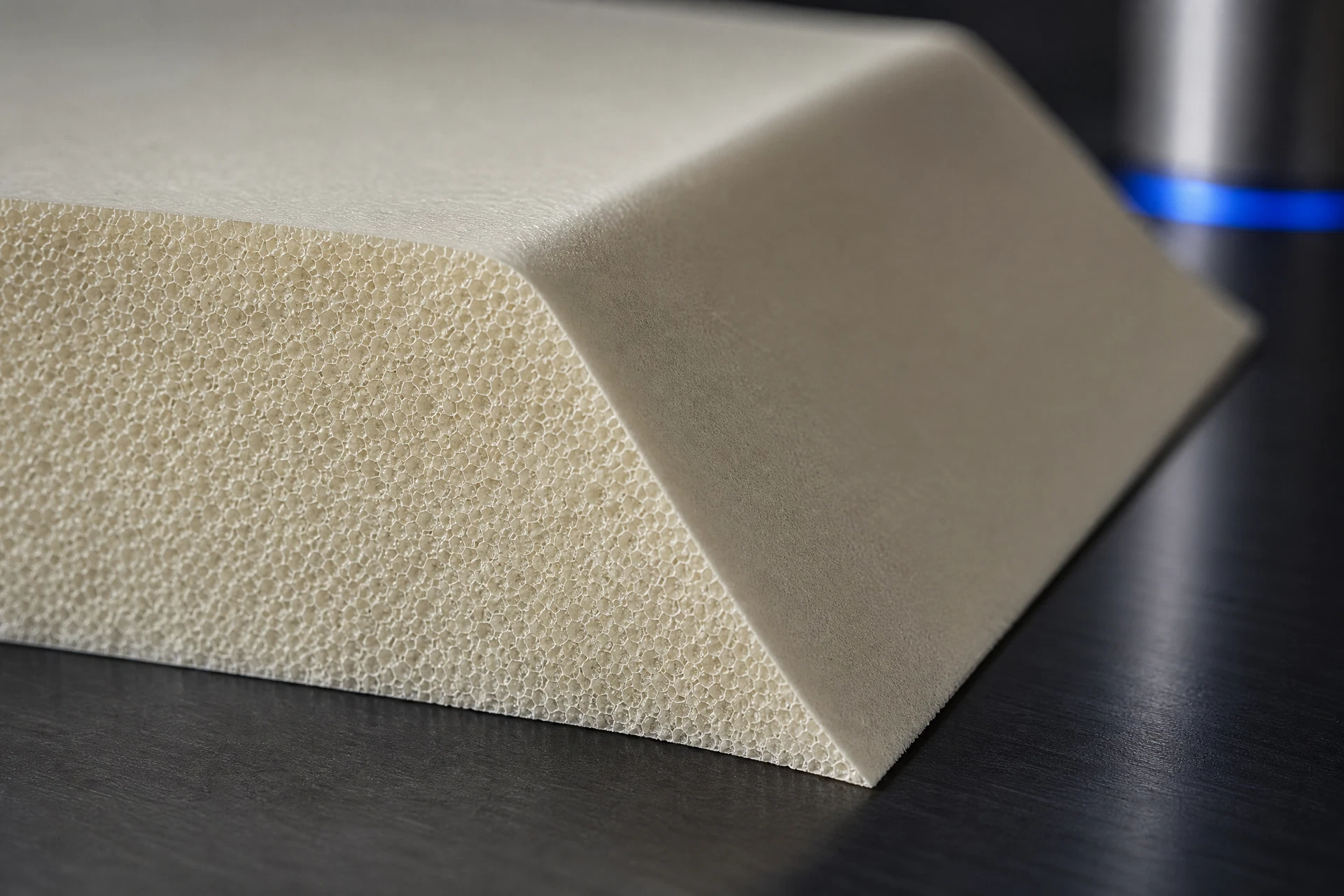
Specific engineering search intent
Drawing and geometry context
Process and handoff review
Controlled technical evidence
Engineering record
Component context
Core & geometry
Process & review

Define the engineering decision
The engineering decision should be based on the complete design envelope rather than material name alone. Confirm the required PMI grade, core architecture, facing or laminate interfaces, joining approach, service environment, and manufacturing sequence. Identify whether the requirement is for sheet, contour-cut, shaped, machined, or another defined form. Procurement should proceed only after the technical specification, revision-controlled drawing, grade documentation, and acceptance criteria are agreed by the project team.
Translate the part into a controlled geometry brief
Geometry must be defined through a project drawing or model that identifies planform, contours, cutouts, radii, inserts, datum references, orientation, and interface surfaces. Do not assume standard dimensions, thickness ranges, or fixed tolerances without written supplier confirmation. State which features are functional, which are process allowances, and which require inspection. Where the core will be bonded, machined, formed, or integrated into a sandwich, include the relevant laminate stack, edge treatment, and assembly references in the drawing package.
Connect the material question to the process route
A practical handoff begins with an inquiry package containing the application description, material form, target grade, geometry files, annual or project quantity, processing route, and requested documentation. CoreMatrix Materials can use that information to clarify manufacturability, identify open technical questions, and define a review sequence. The handoff should separate preliminary feasibility from a controlled quotation or purchase specification, with revision control applied to drawings, data sheets, samples, inspection plans, and any agreed change process.
Keep technical evidence within its stated boundary
Evidence should be requested against the actual project need and applicable PMI grade, not inferred from generic material descriptions. Define which technical data, processing guidance, inspection records, sample evaluations, and test reports are required for review. Any suitability statement remains bounded by the supplied data, test method, specimen configuration, environmental conditions, and manufacturing route. Project validation should confirm geometry, interfaces, processing behavior, and acceptance criteria before design release or production procurement.
Related questions
Questions that make the next engineering conversation more useful.
01What information is needed to evaluate rigid PMI foam core for a project?
Provide the intended material form, candidate grade, geometry or CAD, laminate and interface details, manufacturing process, service environment, quantity context, and documentation requirements. This allows the technical review to distinguish confirmed requirements from items that still need testing or supplier confirmation.
02Can rigid PMI foam core be supplied to a project-specific geometry?
Project-specific forms may be reviewable, but feasibility depends on the drawing, model, processing route, feature definitions, and inspection needs. Submit revision-controlled geometry and identify critical interfaces; any dimensions, tolerances, or supply commitments must be confirmed for the specific project.