
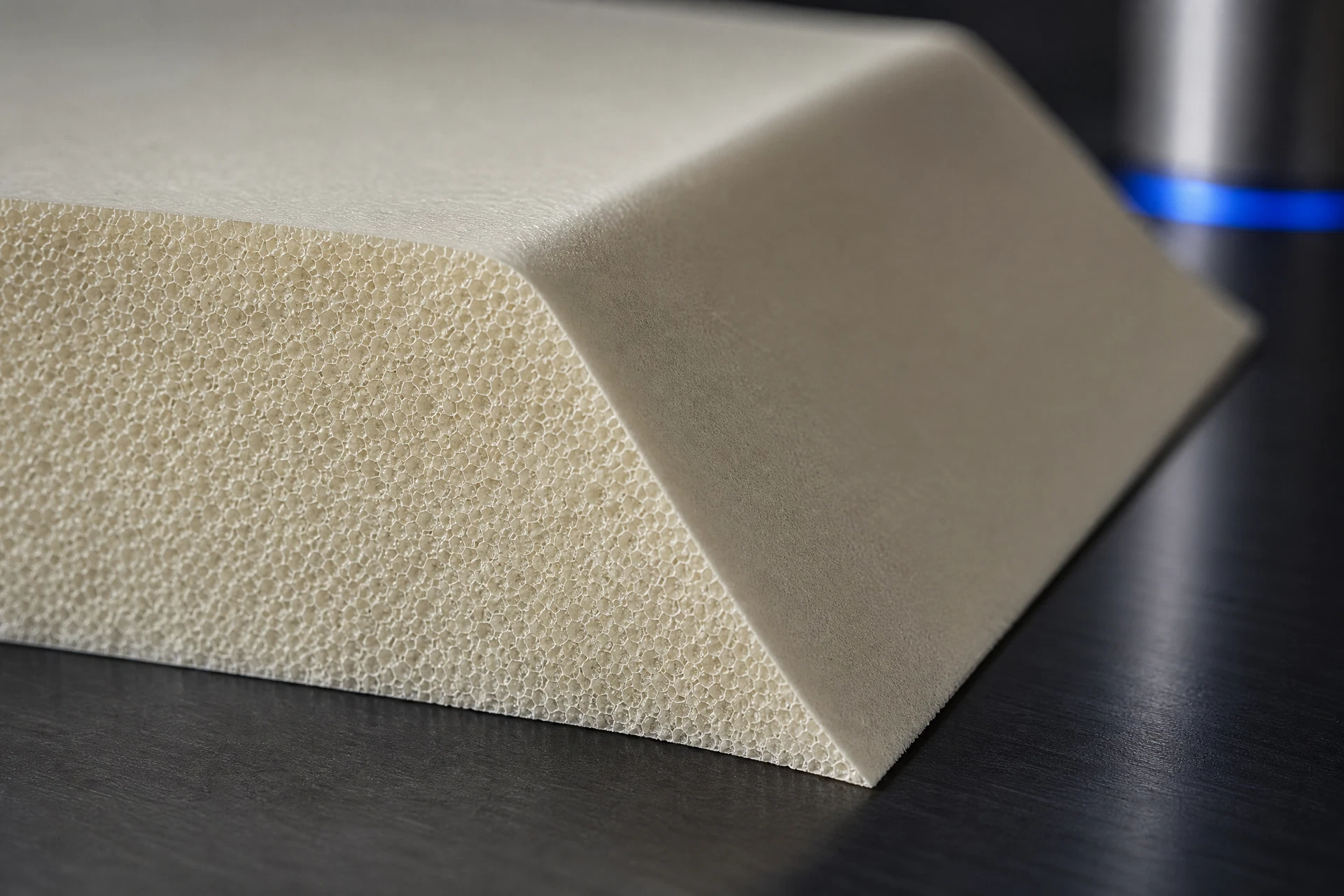
Specific engineering search intent
Drawing and geometry context
Process and handoff review
Controlled technical evidence
Engineering record
Component context
Core & geometry
Process & review
Define the engineering decision
The insert decision should connect the required interface function to a documented PMI foam grade, insert concept, surrounding laminate, and manufacturing process. Review whether the zone needs local load transfer, fastener support, edge closure, bonding access, or another explicitly defined purpose. Do not select by name alone: confirm the applicable grade data, facing and adhesive assumptions, processing limits, and interface details against the project design basis. The outcome should be a traceable engineering decision with open questions, requested evidence, and defined verification activities.
Translate the part into a controlled geometry brief
Define insert geometry from the released or review-stage drawing, not from a generic catalog assumption. Identify the insert boundary, depth, profile, edge treatment, transition to the surrounding core, adjacent laminate, access direction, and any fastener or fitting interfaces. Mark datum references, orientation, local curvature, tooling considerations, and inspection features where relevant. A useful review package includes section views and interface details that distinguish nominal intent from manufacturing allowance. Any dimensions, thicknesses, radii, or tolerances should remain project-controlled and be confirmed before design release.
Connect the material question to the process route
A practical handoff begins with the part definition and interface map, followed by a review of material-grade suitability and the proposed insert-zone construction. Align design, materials, manufacturing, and quality representatives on preparation, placement, bonding or integration steps, cure or processing conditions, and inspection access as applicable to the project. Record assumptions in the drawing or technical data package, then identify samples, process trials, coupons, or assembled-part checks needed for validation. The handoff is complete when responsibilities, inputs, revisions, and approval points are clear.
Keep technical evidence within its stated boundary
Evidence should be requested to match the specific design question rather than treated as a blanket product claim. Gather the applicable PMI foam grade datasheet, traceable material identification, processing guidance, interface or bonding information, and any relevant test method or project qualification record available for review. Confirm that reported data represents the intended grade, configuration, process, and environment; do not transfer values outside their stated boundary. Final acceptance should depend on project-level drawing review, representative process validation, inspection criteria, and documented engineering approval.
Related questions
Questions that make the next engineering conversation more useful.
01What information is needed to review a PMI foam core insert zone?
Provide the part and interface drawings, material stack-up, insert purpose, manufacturing route, joining assumptions, environmental conditions, inspection approach, and applicable grade requirements. Project-specific dimensions and tolerances should come from controlled drawings, while open design questions should be identified for engineering review.
02Does a PMI foam core insert require project validation?
Yes. The need and scope of validation depend on the interface function, geometry, materials, process, and acceptance criteria. Review applicable grade data, run representative process evaluations where needed, and document inspection and approval evidence before treating the insert-zone design as released.