
Specific engineering search intent
Component, geometry, and process context
Controlled material and test-data reading
Project-specific technical review
Engineering record
Component context
Core & geometry
Process & review
Start with the engineering decision
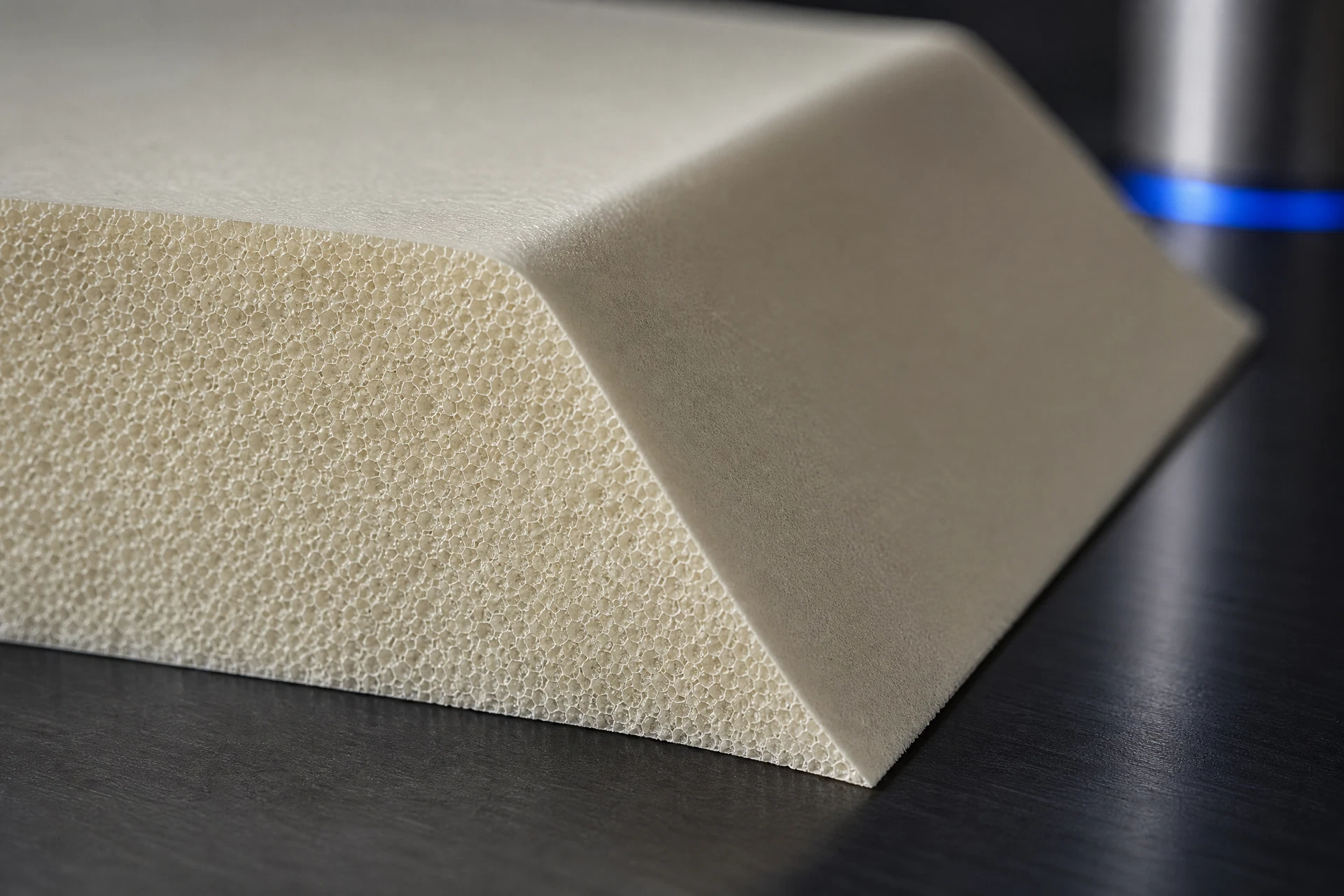
The Chinese PMI TDS identifies XK as a fine-cell family, CK as a coarse-cell family and CX as an ultra-fine-cell family; it also reports a closed-cell rate of 95%–98%. These descriptions help organize a grade discussion, but they do not determine final material selection by themselves. The relevant grade, density direction, mechanical and thermal data, form, thickness and process requirements must remain attached to the actual component.
Translate the component into a controlled core brief
Cell-family language becomes practical only when the drawing and finished core form are known. A flat sheet, a shaped shell, a grooved panel and a complex CNC-prepared core can raise different surface, contour, interface and handling questions. The RFQ should therefore pair the requested material family with the CAD model or dimensions that define the real part.
Connect the material question to the process route
Do not use a general closed-cell statement as automatic proof of resin behaviour, bonding outcome, process compatibility or finished-panel performance. State the laminate or resin route, temperature and pressure context, intended machining or forming steps, and the property question that needs a grade-specific answer. This turns a material-description search into a traceable project review.
Keep technical evidence within its stated boundary
A responsible data record distinguishes material-family description, named-grade TDS values and single-test sample results. Each has a different scope. Ask for the current applicable datasheet and confirm the project’s requirements before release; a broad cell-structure statement should not be promoted into a universal performance or suitability guarantee.
Related questions
Questions that make the next engineering conversation more useful.
01Does a closed-cell rate select the final PMI foam grade?
No. It is one material descriptor. Final selection must consider the named grade, component geometry, thickness, process and applicable technical documentation.
02Why should the cell family be mentioned in a drawing-led enquiry?
It can help organize the material direction, while the drawing and process information explain whether that direction is relevant to the actual finished core.