
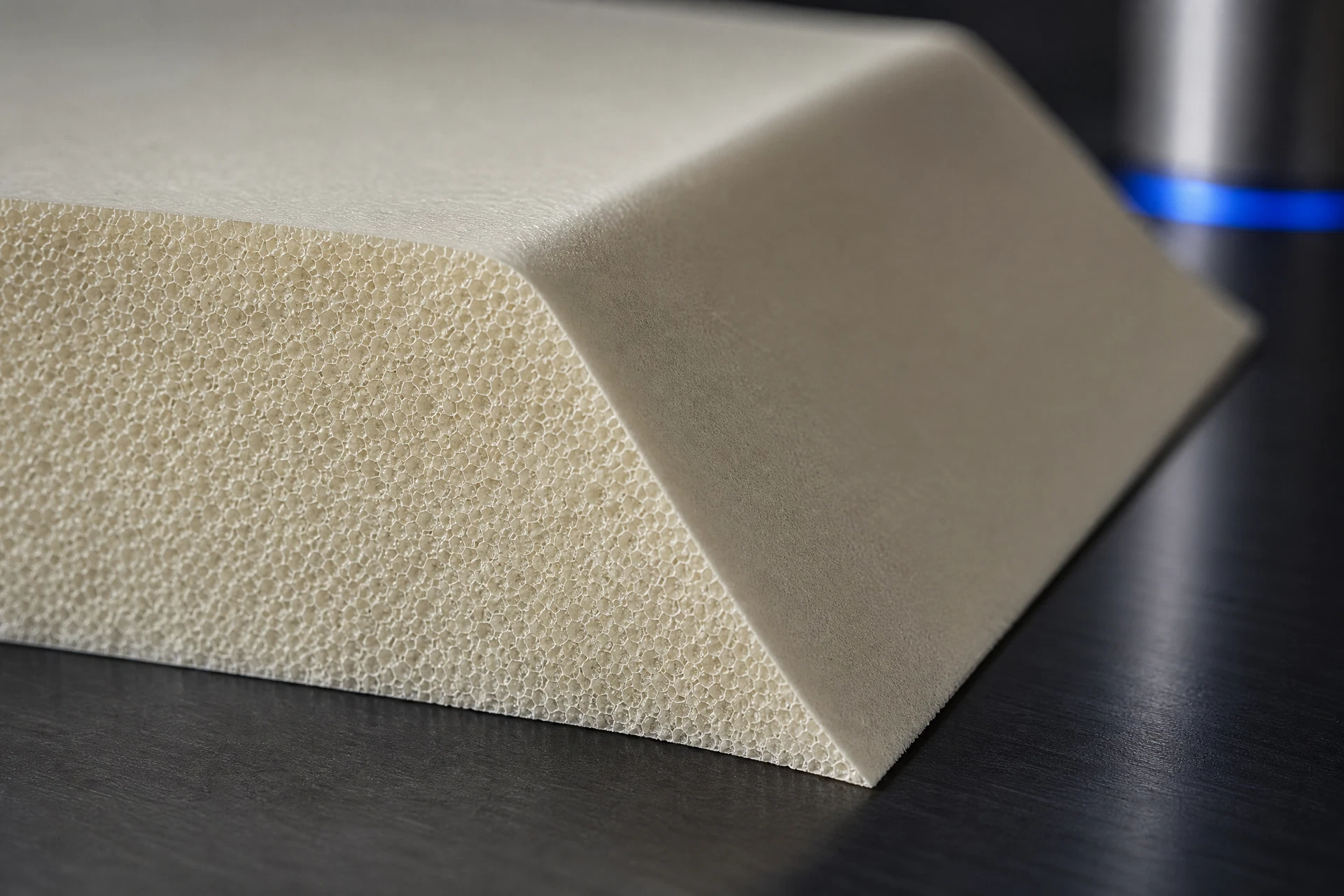
Specific engineering search intent
Drawing and geometry context
Process and handoff review
Controlled technical evidence
Engineering record
Component context
Core & geometry
Process & review

Define the engineering decision
The engineering decision is whether a PMI foam sandwich can be defined and manufactured consistently for the proposed part, not whether a foam name alone guarantees an outcome. Review should compare the requested core grade and facing system with temperature, loads, joining details, curvature, inserts, and production route. Consider whether the design needs bonded skins, co-cured construction, machined contours, local reinforcements, or post-bond operations. Select a route only after the drawing, material basis, process window, and verification responsibilities are agreed.
Translate the part into a controlled geometry brief
Provide a controlled drawing or model showing overall envelope, core boundaries, skin transitions, radii, tapers, steps, cut-outs, inserts, joints, datum strategy, and access for bonding and inspection. Identify regions where the core is shaped, locally thickened, interrupted, or replaced by another feature. Define surface directions, ply or facing orientation where relevant, and interfaces that require masking or preparation. Geometry review should resolve manufacturability questions before release; any dimensions, tolerances, or thicknesses must come from the project definition rather than an assumed standard.
Connect the material question to the process route
A typical handoff moves from requirements and geometry review to material and adhesive selection, laminate or facing definition, core preparation, fit-up, bonding or cure planning, trimming, inspection, and documentation. The exact sequence depends on part architecture, tooling, temperature limits, joint design, and whether operations are manual, press-assisted, oven-based, or otherwise specified by the program. The process package should identify work instructions, critical controls, handling limits, inspection points, nonconformance treatment, and revision ownership. Production release should follow agreed trial and validation steps.
Keep technical evidence within its stated boundary
Request the applicable PMI grade data, facing and adhesive technical information, safety or handling documentation where relevant, and any process guidance relied upon for the design. Evidence should be tied to the intended construction and test method; generic datasheets do not establish part-level suitability. Define what must be demonstrated through coupons, representative panels, first-article inspection, dimensional checks, bond assessment, environmental exposure, or other project-approved verification. CoreMatrix Materials can support the evidence request, while the engineering authority retains responsibility for acceptance criteria and validation.
Related questions
Questions that make the next engineering conversation more useful.
01What information is needed to review a PMI foam composite sandwich process?
Start with the part drawing or model, intended PMI grade, skin and adhesive concept, service conditions, joining details, tooling assumptions, and required inspection approach. These inputs allow a focused review of geometry, process risk, evidence needs, and project-specific validation without relying on unsupported material or performance assumptions.
02Can PMI foam sandwich manufacturing be defined from a material datasheet alone?
No. A datasheet is only one input. Manufacturing suitability also depends on geometry, facing architecture, adhesive and cure route, handling, tooling, inspection, and acceptance criteria. The project should confirm the applicable grade and process through controlled documentation, representative verification, and review of the released engineering definition.